Most people read important documents in the wrong order.
They start with the last page.
Then they look for the signature box.
Then they ask:
“Where do I sign?”
A better question is:
“What exactly am I agreeing to?”
Whether it is a property agreement, business contract, partnership document, lease, loan document or another legally significant instrument, the words you sign can determine what you are required to do later.
The Indian Contract Act, 1872 sets out fundamental principles concerning contracts, including free consent, lawful consideration and lawful objects. It also addresses performance and consequences of breach. (India Code)
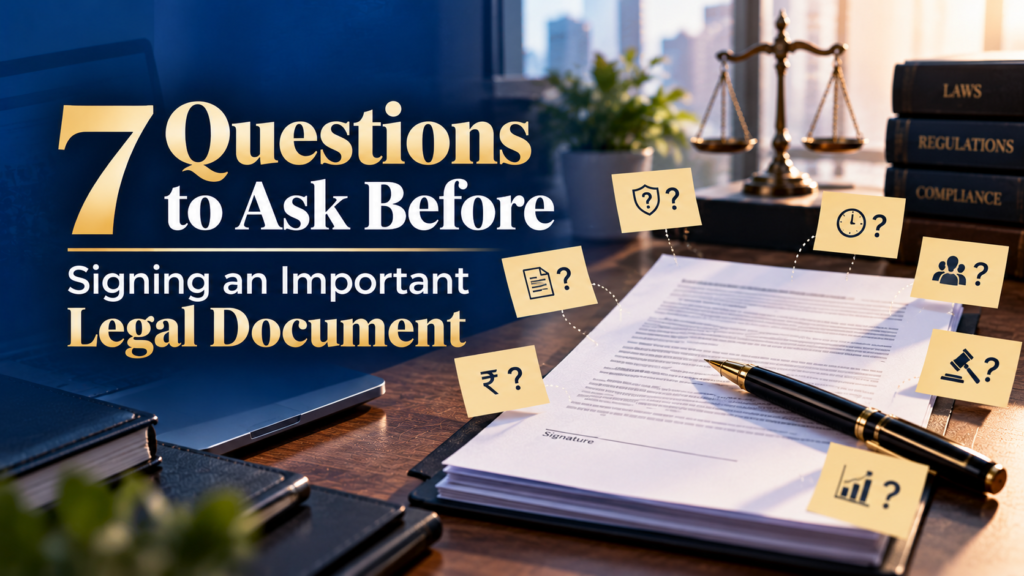
Here are seven questions worth asking before signing.
1. What exactly am I agreeing to?
This sounds obvious, but it is often the most important question.
Do not rely only on the title.
A document titled “Agreement” can contain obligations that are very different from what you understood during the discussion.
Identify:
- Your obligations
- The other party’s obligations
- Payment obligations
- Timelines
- Conditions
- Restrictions
- Rights on termination
- Consequences of breach
If you cannot explain the document in simple language, you probably have not understood it well enough to sign it.
2. What happens if I do not perform?
Every important agreement should be read with a second scenario in mind:
What happens if something goes wrong?
Look for clauses dealing with:
- Default
- Delay
- Interest
- Penalties
- Damages
- Termination
- Indemnity
- Dispute resolution
The Contract Act contains provisions dealing with compensation for loss caused by breach of contract and compensation where a contract stipulates a penalty. (India Code)
The exact consequences depend on the contract and circumstances.
3. Can the other party change the terms later?
Look carefully for clauses dealing with unilateral changes.
Ask:
Who can change what?
For example:
- Can the price change?
- Can delivery dates change?
- Can specifications change?
- Can services be modified?
- Can the contract be terminated without your consent?
A clause that gives one party broad discretion deserves careful attention.
4. When can the agreement be terminated?
Many people focus on how an agreement starts and forget to understand how it ends.
Look for:
Termination for convenience
Termination for breach
Notice period
Cure period
Refund consequences
Outstanding payment obligations
Effect of termination
The termination clause can become one of the most important provisions when a relationship breaks down.
5. Where will a dispute be resolved?
Check the dispute-resolution clause.
It may provide for:
- Courts
- Arbitration
- Mediation
- Conciliation
- A particular jurisdiction
If arbitration is mentioned, understand what that means before signing.
The contract may also specify the seat or venue of arbitration, appointment mechanisms and other procedural terms.
These details can materially affect how a dispute proceeds.
6. What am I giving up?
Not every important clause tells you what you must do.
Some tell you what you cannot do.
Look for:
- Restrictions
- Waivers
- Exclusivity
- Non-compete provisions where legally applicable
- Liability limitations
- Indemnities
- Rights assigned to the other party
- Confidentiality obligations
A clause can be short and still have significant consequences.
7. What documents are incorporated into this agreement?
This is one of the easiest things to miss.
An agreement may refer to:
- Annexures
- Schedules
- Policies
- Technical specifications
- Previous correspondence
- Terms and conditions
- Manuals
- Statements of work
If those documents form part of the agreement, read them too.
Do not sign a document while assuming that an attachment is “just for reference” unless you have confirmed its legal role.
A simple example
Imagine a business owner signs a service agreement.
The main page says:
“₹2 lakh per month.”
The business owner reads that and signs.
Later, they discover that the agreement also contains:
- A minimum 12-month commitment
- Automatic renewal
- Early termination charges
- An indemnity clause
- A limitation of liability
- Arbitration provisions
The problem was not necessarily that the contract was unusually long.
The problem was that the commercial decision was made without understanding the legal terms attached to it.
What should you do before signing?
Use this simple sequence:
STEP 1
Read the entire document.
STEP 2
Mark anything you do not understand.
STEP 3
Identify your financial obligations.
STEP 4
Identify your deadlines.
STEP 5
Read termination and default clauses.
STEP 6
Read dispute-resolution provisions.
STEP 7
Check all annexures and referenced documents.
STEP 8
Ask for changes in writing where necessary.
STEP 9
Keep the final signed version.
STEP 10
Do not sign simply because someone says: “Everyone signs this.”
When should you get a document reviewed?
Not every document requires the same level of scrutiny.
Independent legal review becomes particularly relevant when the document involves:
- Significant money
- Property
- Business ownership
- Long-term obligations
- Personal guarantees
- Shareholding
- Intellectual property
- Liability exposure
- Complex commercial arrangements
- Termination consequences
The cost of understanding a document before signing it can be very different from the cost of dealing with a dispute after signing it.
Final takeaway
A signature is not just an acknowledgement that you received a document.
It can create obligations.
Before signing, ask:
What am I agreeing to?
What happens if something goes wrong?
What am I giving up?
How can this agreement end?
If the answers are unclear, pause before signing.