
A legal notice can be intimidating.
The language may sound serious. There may be references to sections of law, demands for payment, allegations and a deadline for response.
The first reaction is often:
“Am I being sued?”
Not necessarily.
A legal notice is generally a formal communication in which one party sets out a grievance, demand or proposed legal action. Its significance depends on the facts, the document itself and the law involved.
A notice should not simply be ignored, but it also should not be treated as if it were already a court judgment.
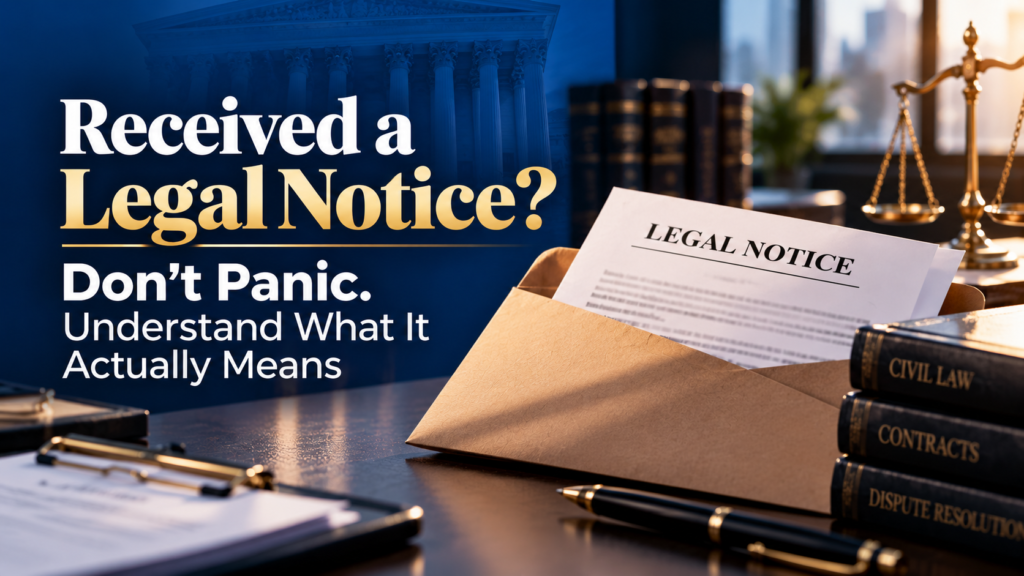
What is a legal notice?
A legal notice is a formal communication sent by one party to another to communicate a claim, demand, grievance or proposed course of legal action.
The purpose can vary considerably.
For example, a notice may relate to:
- A contractual dispute
- Unpaid money
- Property issues
- Breach of agreement
- Cheque dishonour
- Employment-related disputes
- Business disputes
- Consumer issues
- Defamation allegations
- Recovery claims
The legal consequences also vary depending on the nature of the notice.
That is why the first step should be to identify what kind of notice you have actually received.
Does receiving a legal notice mean you have lost the case?
No.
A notice is not itself a court judgment.
It represents the position or demand of the person who sent it. Whether that position is legally sustainable depends on the facts, documents and applicable law.
But that does not mean the notice can be ignored.
A poorly handled notice can become more complicated if formal proceedings are later initiated.
Step 1: Read the entire notice
Do not read only the first page.
Look for:
- Who sent it
- On whose behalf it was sent
- What allegations are made
- What documents are referred to
- What is being demanded
- Whether a specific amount is claimed
- What deadline has been given
- What action is threatened if you do not comply
Make a copy of the complete notice and preserve the envelope, email or other delivery record where relevant.
Step 2: Identify the underlying dispute
Ask:
What is this actually about?
Sometimes the language is complicated but the underlying issue is straightforward.
For example:
“You have failed to perform your contractual obligations…”
may ultimately be a dispute about an unpaid invoice.
Or:
“You are liable for damages…”
may arise from an alleged breach of a specific agreement.
Understanding the underlying issue is more useful than being intimidated by legal terminology.
Step 3: Find the documents
Documents often determine what can actually be established.
Depending on the matter, collect:
- Agreements
- Invoices
- Payment records
- Emails
- WhatsApp communications
- Property documents
- Notices previously exchanged
- Receipts
- Bank statements
- Relevant photographs
- Government or authority communications
Do not selectively collect only documents that support your side.
Preserve the complete record.
Step 4: Check the deadline
If the notice asks for a response within a particular period, note the date immediately.
Do not wait until the last day to start examining the matter.
The consequences of missing a deadline can depend on the specific legal provision involved.
- Agreements
- Invoices
- Payment records
- Emails
- WhatsApp communications
- Property documents
- Notices previously exchanged
- Receipts
- Bank statements
- Relevant photographs
- Government or authority communications
Do not selectively collect only documents that support your side.
Preserve the complete record.
Step 5: Do not reply emotionally
This is one of the most common mistakes.
You receive an allegation.
You become angry.
You send a five-page WhatsApp message explaining why the other person is dishonest.
That message may later become part of the record.
A legal response should be based on facts, documents and applicable law, not frustration.
Step 6: Check whether the allegations are supported by documents
Suppose someone claims:
“You agreed to pay ₹10 lakh by 30 June.”
The next question is:
Where is that obligation recorded?
Look at the agreement, invoice, correspondence or other relevant evidence.
Indian contract law recognises that enforceability depends on factors including lawful consideration and object, free consent and competency to contract. The Indian Contract Act, 1872 also contains provisions dealing with breach and compensation.
Step 7: Understand what the sender actually wants
A notice may demand:
- Payment
- Performance of a contractual obligation
- Cancellation
- Refund
- Possession
- Documents
- Cessation of an activity
- Compensation
- A response within a specified period
You cannot assess the appropriate response without understanding the demand.
Step 8: Take special care with statutory notices
Some notices are connected to specific statutory procedures.
For example, a notice under a particular law may have consequences that differ significantly from an ordinary demand letter.
The response strategy should therefore depend on the legal provision involved.
What if the notice contains incorrect facts?
Do not simply respond:
“Everything written here is false.”
Identify the specific statements that are disputed.
Then support the response with documents wherever possible.
For example:
Claim: Payment was never made.
Response: Payment was made on 15 July.
Evidence: Bank transaction reference and corresponding invoice.
That is much stronger than an emotional denial.
What if you actually owe the money?
The purpose of legal advice is not always to fight every demand.
Sometimes the documents may show that an obligation exists.
The appropriate response may then involve understanding:
- The amount actually due
- Contractual interest
- Applicable timelines
- Whether there is a genuine dispute
- Whether settlement is possible
- What happens if no resolution is reached
The correct approach depends on the facts.
What if you do nothing?
That depends on the nature of the notice and the applicable law.
A legal notice is not automatically a court order, but ignoring a notice can be risky where further legal proceedings, statutory timelines or other consequences may follow.
The safest general approach is simple:
Read it. Preserve it. Understand it. Respond appropriately.
A simple first-response checklist
If you receive a legal notice today:
- Save the complete notice.
- Note the date of receipt.
- Identify the sender and the legal issue.
- Read the demand carefully.
- Collect all relevant documents.
- Do not send an angry reply.
- Check whether a specific statutory deadline applies.
- Obtain legal advice where the matter is significant or disputed.
Final takeaway
A legal notice is a point in a dispute, not necessarily the end of it.
The most useful first question is not:
“How do I fight this?”
It is:
“What exactly is being alleged, what documents support it, and what legal consequence follows if I do not respond?”
Once those questions are clear, the next step becomes much easier to determine.




1 thought on “Received a Legal Notice? Don’t Panic. Understand What It Actually Means”
Zuerst sollte man frische Krauter auswahlen, die gut zu den Gerichten passen, die man zubereiten mochte.
Sie mochten herbal salt recipe selbst herstellen, um ein aromatisches und naturbelassenes Krautersalz zu erhalten.
Krautersalz ist eine wunderbare Wurze, die jedem Gericht eine besondere Note verleiht.Selbstgemachtes Krautersalz ist nicht nur lecker, sondern auch eine tolle Geschenkidee fur Freunde und Familie.